The Short Answer
To get a car loan with bad credit in Canada, you need to be the age of majority in your province, hold a valid Canadian driver's licence, and show steady income of at least $1,800 per month before taxes. No minimum credit score is set by law — subprime lenders set their own thresholds, and many approve borrowers in the 500–620 range when income and employment are stable.
Table of Contents
- What Lenders Actually Check
- Minimum Income Requirements
- Minimum Requirements by Lender Type
- Down Payment — How Much and Why It Matters
- The Document Checklist
- Which Type of Lender to Use
- How a $2,000 Trade-In Bonus Changes the Math
- Using a Bad Credit Car Loan to Rebuild Your Score
- When This Won't Help You
- Frequently Asked Questions
The minimum requirements for a car loan with bad credit in Canada are simpler than most guides make them sound: legal age, a valid licence, a Canadian address, and steady income above $1,800 per month. Your credit score matters, but it's not the wall you think it is.
Subprime lenders — the specialists in this space — look at your full financial file, not just three digits. Income stability, employment history, the size of your down payment, and your total debt load all factor into the decision. A score in the 550s with solid employment and 10% down gets approved every week. A score of 700 with three months of contract income and no savings sometimes doesn't.
This guide covers every requirement in detail: what each one means, how to meet it, and what to do when you're short on one of them. Two things competing guides rarely mention: how a $2,000 trade-in bonus can substitute for part of your down payment, and the specific situations where applying will cost you a credit hit without getting you a car.

What Lenders Actually Check

Banks use a fairly blunt instrument: pull the credit score, check it against a threshold, approve or decline. Subprime lenders work differently. They read the whole file and make a judgment call.
The five factors they assess, in rough order of weight:
- Income stability — not just how much you earn, but how consistently you've earned it
- Employment history — length of time at current employer, or track record if self-employed
- Down payment size — higher down payments reduce lender risk and almost always improve approval odds
- Debt-to-income ratio (DTI) — total monthly debt obligations divided by gross monthly income. Below 40% is workable; above 50% is a problem for most lenders
- Credit score and history — it matters, but it's one of five factors, not the deciding one
A credit score is a snapshot, not a life sentence. A single missed payment from two years ago carries far less weight than six months of steady paycheques and a $3,000 down payment sitting in your account. Lenders who understand this space read the story, not just the number.
The Financial Consumer Agency of Canada publishes guidance on what lenders can and cannot use in credit decisions — worth reading before you apply anywhere.
Minimum Income Requirements
Most subprime lenders set a minimum gross monthly income of $1,800 to $2,000 before taxes. Some lenders have raised this floor in 2026 as household debt concerns have grown — 68% of Canadian car buyers now cite debt load as their primary financial concern.
What counts as income varies by lender:
- Employment income — full-time, part-time, and seasonal all count. Part-time work may require a longer employment history to satisfy underwriters.
- Self-employment income — typically requires two years of Notices of Assessment (NOAs) from the CRA plus recent bank statements. One good year isn't enough for most lenders.
- Government benefits — EI, ODSP, and CPP are accepted by some lenders but not all. Ask explicitly before applying.
- Pension income — generally accepted. Predictable, documented, and stable — which is what lenders want to see.
The monthly payment on the vehicle typically cannot exceed 15–20% of your gross monthly income, depending on the lender. On a $1,800 monthly income, that means a maximum payment in the $270–$360 range. At current subprime rates, that funds a vehicle in the $10,000–$13,000 range over 60 months. Know your number before you start browsing inventory.
Minimum Requirements by Lender Type

Not all lenders use the same checklist. "Minimum requirements" means something different at a bank versus a specialist lender versus a buy-here-pay-here lot. Here's the honest comparison:
The BHPH row looks easy until you see the fine print: no bureau reporting (so it doesn't rebuild your credit), rates typically 25%–35%, and limited inventory. Specialist lenders are the better option for almost every bad-credit file — they report to Equifax and TransUnion, the vehicles are standard market inventory, and the rates, while high, are meaningfully lower.
One thing competitors rarely mention: Canadian credit bureaus group auto loan inquiries made within a 14-day window and treat them as a single rate-shopping event. Apply with multiple lenders during that window and the score impact is the same as applying with one. Spread those applications over two months and each one counts separately.
If you're unsure where your score stands, you can check for free through Equifax Canada before submitting any applications.
Down Payment — How Much and Why It Matters
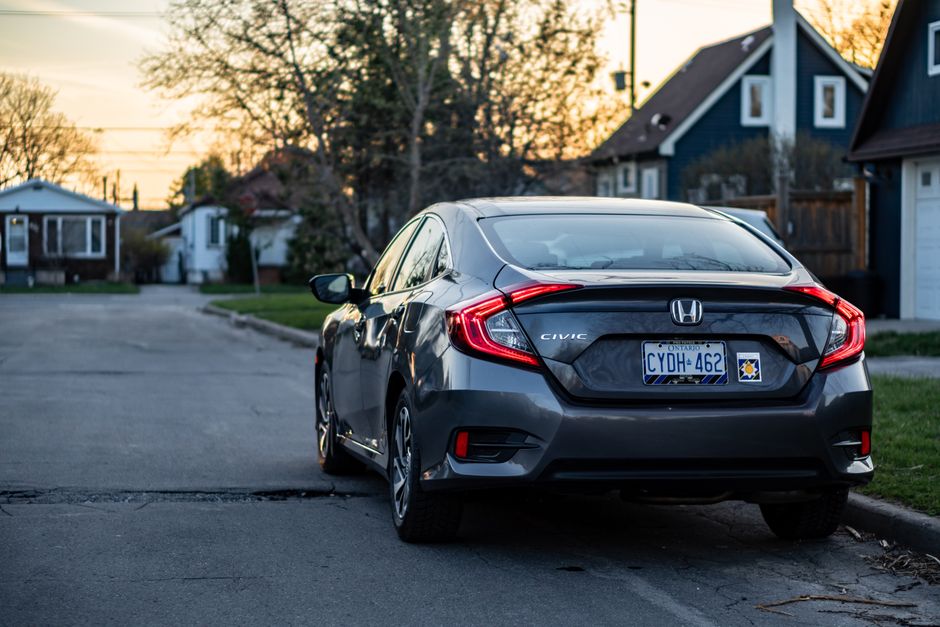
A down payment isn't always required, but it almost always helps. Here's the honest breakdown.
Subprime lenders take on additional risk when they approve a borrower with a damaged credit history. A down payment reduces that risk by lowering the loan-to-value ratio — the amount borrowed relative to the vehicle's worth. A 10% down payment on a $15,000 car means you're financing $13,500, not $15,000. That difference changes what the lender is exposed to if payments stop.
Practical guidance by score range:
- 500–619: Aim for 10–15% down. Some lenders require it as a condition of approval.
- Below 500: 20% or more significantly improves your odds. Below this threshold, the down payment can be the deciding factor between approval and decline.
- No down payment: Possible in the 550+ range with strong income. Expect a higher rate to compensate for the lender's added exposure.
One thing that catches buyers off guard: the sticker price and the out-the-door cost aren't the same number. In Ontario, HST applies on the full purchase price. In Alberta, GST applies. Licensing and registration fees stack on top. Budget your down payment against the all-in cost, not just the listed price.
The Document Checklist
Having your documents ready before you apply is the single fastest way to get a same-day decision. Incomplete files sit in the underwriting queue while someone chases down missing items. Complete files move immediately.
Standard requirements for a bad credit car loan in Canada:
- Government-issued photo ID — driver's licence or passport
- Proof of income, dated within 30 days — recent pay stubs covering 2–3 pay periods, or Notices of Assessment for self-employed applicants
- Proof of address, dated within 90 days — utility bill, bank statement, or government correspondence
- Social Insurance Number (SIN) — required to run the credit check
- Banking information — for pre-authorized payment setup (void cheque or direct deposit form)
- References — 2–3 personal or professional references. Some subprime lenders require these; others don't. Ask before you apply.
Self-employed applicants should also prepare 3–6 months of bank statements in addition to the two years of NOAs from the CRA. If your declared income doesn't match your actual deposits, the underwriter will notice the gap.
Newcomers to Canada without an established credit file should have their passport, proof of immigration status, and any international credit documentation available. Some lenders run newcomer-specific programs — ask directly whether the lender has one before submitting a full application.
Which Type of Lender to Use

The lender type matters as much as the requirements you meet. Not every lender who advertises bad credit financing actually specializes in it.
Banks and credit unions. If your score is below 660, most major banks will decline outright or offer terms that aren't worth accepting. Credit unions can be more flexible — they assess character and community standing in ways banks can't — but they still rely heavily on credit scores. For scores below 620, move on.
Dealer financing. Dealerships work with their own financing arms and a roster of third-party lenders. A Finance Manager at a dealership can shop your profile across multiple lenders, but the selection is limited to their specific lender relationships. They're also often incentivized to place you with the product that earns the highest commission — which isn't necessarily the best rate for you.
Online brokers and specialists. Services like Direct Finance submit your file to 10–20 lenders under a single application — one hard inquiry, multiple competing offers. Your Local Expert, a dedicated Finance Manager, reviews your file personally and advocates across the lender network. You can complete the entire process without visiting a lot, and get the car delivered to your door. Most applications receive a same-day response; traditional bank approvals take 2–4 weeks. If you're ready to apply, start your pre-approval here.
Private lenders. For borrowers below 500, or those in undischarged bankruptcy, private lenders fill the gap conventional options won't. Rates are higher, but they let you establish a payment history over 12–18 months and then refinance at a better rate. Think of it as a one-time toll to get back on track, not a permanent condition. For more on this path, read our guide to bad credit car loans in Canada.
How a $2,000 Trade-In Bonus Changes the Math
Most bad-credit car loan guides skip the trade-in discussion, which is odd because a trade-in is one of the most practical tools for strengthening an application.
Here's the logic: your current vehicle has value. Even a high-mileage car worth $4,000 privately is still worth something in trade. At Direct Finance, qualified buyers can receive up to a $2,000 trade-in bonus on top of the vehicle's assessed value — applied directly to your down payment.
Return to the earlier example: a buyer with a 560 score who would otherwise struggle to produce 10% down on a $15,000 vehicle now has a meaningful head start. The trade-in value plus the $2,000 bonus could cover half or more of the required down payment. That shifts the conversation with lenders from "marginal approval" to a clean, well-structured file.
Even if you don't have a trade-in vehicle, it's worth asking about the current bonus offer before assuming a down payment is out of reach. The keener move is to know what your current vehicle is worth before you start the application — that number changes the budget math before you've spent a dollar.
Using a Bad Credit Car Loan to Rebuild Your Score
A car loan is an installment loan. On-time payments get reported to Equifax and TransUnion. Payment history is the single largest factor in your credit score — roughly 35% of the calculation. A 24-month track record of clean auto loan payments, with no new derogatory marks, can shift a 560 meaningfully toward the 620+ range where better rates are available.
The path is straightforward: pay on time for 12–18 months, then contact your lender or broker about a rate refinance. The car is already yours, the payment history is established, and the improved score qualifies you for better terms. Our guide to auto financing pre-approval covers how to position your file for the strongest possible terms when that window opens.
A few things that accelerate the rebuild:
- Keep the payment-to-income ratio manageable. A car payment that strains your budget leads to missed payments, which undoes the rebuild faster than anything else.
- Don't open new credit accounts during the loan term if you can avoid it. Each hard inquiry and new account creates a short-term drag on the score.
- If you have old collections or charge-offs, address them separately. A clean auto payment history doesn't erase other derogatory items sitting on your file.
The pre-approval Direct Finance provides is valid for 6 months — giving you real time to shop without pressure, rather than rushing into a vehicle that doesn't fit the budget. That's a different experience than a standard 30-day approval window from a bank or dealer, which creates pressure to decide fast.
Ready to check your rate?
One 5-minute application. 10–20 lenders competing for your business. Same-business-day response.
Start Your Pre-Approval — It's FreeWhen This Won't Help You

We're going to be direct here, because most guides in this space aren't.
If your income is below $1,800 per month. Most subprime lenders set this as a hard floor. Below it, the monthly payment on any reasonable vehicle will exceed 20% of gross income, which lenders view as unsustainable. A weak approval at a rate you can barely afford is worse than no approval — it sets you up for default and damages your credit further. Wait until your income stabilizes before applying.
If you're actively in undischarged bankruptcy. Standard subprime lenders won't work with this situation. Specialist lenders exist, but the rates are high and vehicle options are narrow. Contact us before submitting anything — we'll tell you honestly what's realistic for your situation before a hard inquiry goes on your file for a loan that won't come through.
If you've had a repossession in the past 12 months. A recent repo is a significant flag for most subprime lenders. The 12-month mark is a common threshold — some lenders won't review a file until a year has passed since the repossession date. In this situation, the private lender path is more realistic.
If your debt-to-income ratio is above 50%. Monthly obligations that already consume more than half of gross income don't leave room for an additional car payment in most lenders' models. Pay down existing debt first, then apply. Adding another loan on top of an already stretched DTI increases your default risk, and lenders price that in — or decline entirely.
If you have excellent credit. This guide isn't for you. A score above 700 with stable income and some savings means you should walk into your bank or credit union directly. You'll get a competitive rate with minimal friction and you don't need a broker to get it. We'd rather lose that business than have you waste time on a process that adds no value.
Frequently Asked Questions
Direct Finance Team
Published May 7, 2026 · Last updated May 7, 2026
The Direct Finance Team works with lenders across Canada to match buyers with auto financing that fits their actual situation — including buyers the banks have already turned down. About Direct Finance →